
Menominee County Court Arrest Records
Menominee County court records after a jail arrest are built around the formal charge, not the fact of booking alone. Official local sources describe a clear path. Law enforcement investigates, may arrest a person at once, or may send a charging or warrant request to the Menominee County Prosecuting Attorney. The prosecutor reviews reports, witness statements, records, and prior history, then decides whether a criminal charge should issue. That point matters because the prosecutor's page says prosecutors issue criminal charges, not police, except where an appearance ticket can be issued.
If a charge is approved, the government begins the criminal case by filing a complaint in 95A District Court. District Court handles initial arraignments for adult misdemeanor and felony cases, including bail and bond. A felony can later move to the 41st Circuit Court if probable cause is found or the preliminary examination is waived. Booking and custody details belong with Menominee County jail inmate records, while booking photos belong with Menominee County jail mugshots. The court record is the charge and case file that follows the arrest.
The Menominee County prosecutor criminal-case process page shows how investigation, arrest, complaint review, arraignment, probable cause conference, preliminary examination, trial, sentencing, and appeal fit together. That official process source is useful when a MiCOURT entry is hard to read or when a booking charge does not match the later court filing.
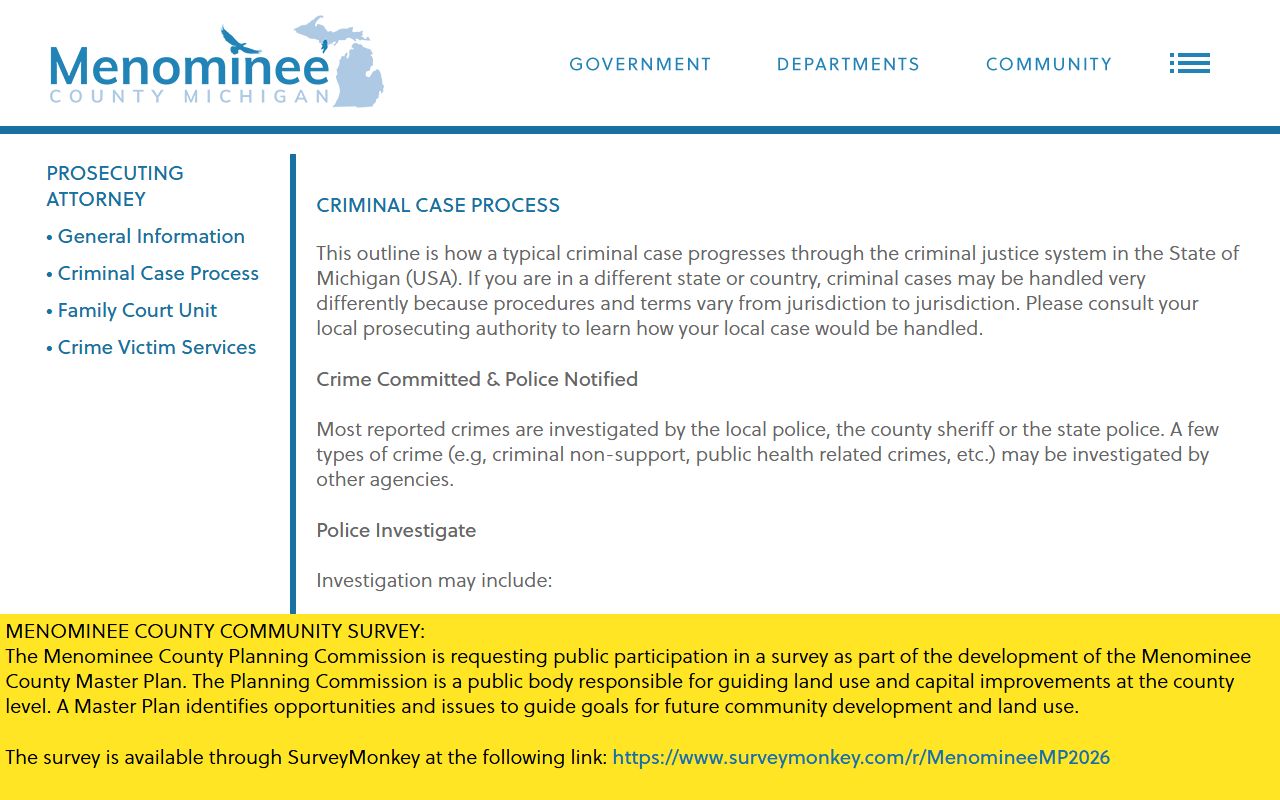
The prosecutor process screenshot is a local source for the arrest to court pathway because it explains who reviews police reports and how charges move into District Court.
Find Menominee County Court Records
The main online search channel for Menominee County court records after an arrest is MiCOURT Case Search, the official Michigan judiciary case-search portal. The portal is separate from jail custody. It is used for participating court case data, such as party names, case numbers, case types, charges, hearing dates, and case status when those fields are available. Because the system is statewide and dynamic, Menominee County court participation and the exact fields should be checked in the portal at the time of search.
- Open MiCOURT Case Search and choose the court or jurisdiction filter if the portal offers one for the search mode.
- Search by defendant name, using date filters or case type filters when the search page provides them.
- Use the case number instead of a name if a bond receipt, summons, notice, or clerk communication gives that number.
- Open the case entry and read the charge list, next hearing, disposition, and court location together.
- Call the correct clerk if a result is missing, sealed, unclear, or not current enough for a deadline.
For District Court criminal cases, the 95A District Court clerk can be reached at 906-863-8532 at 839 10th Ave, Menominee, MI 49858, Monday through Friday, 8:00 AM to 4:30 PM, closed holidays. For felony cases that have moved to Circuit Court, the 41st Circuit Court and County Clerk number is 906-863-9968 at the same courthouse address, with the same posted hours and lunch availability noted by the county. The prosecutor's office, led by Jeffrey T. Rogg, is another source for prosecution role and victim-service routing, but the court clerk remains the place to verify the public case record.
The MiCOURT Case Search portal is the state source used to find the case record after a Menominee County arrest when participating court data is available.
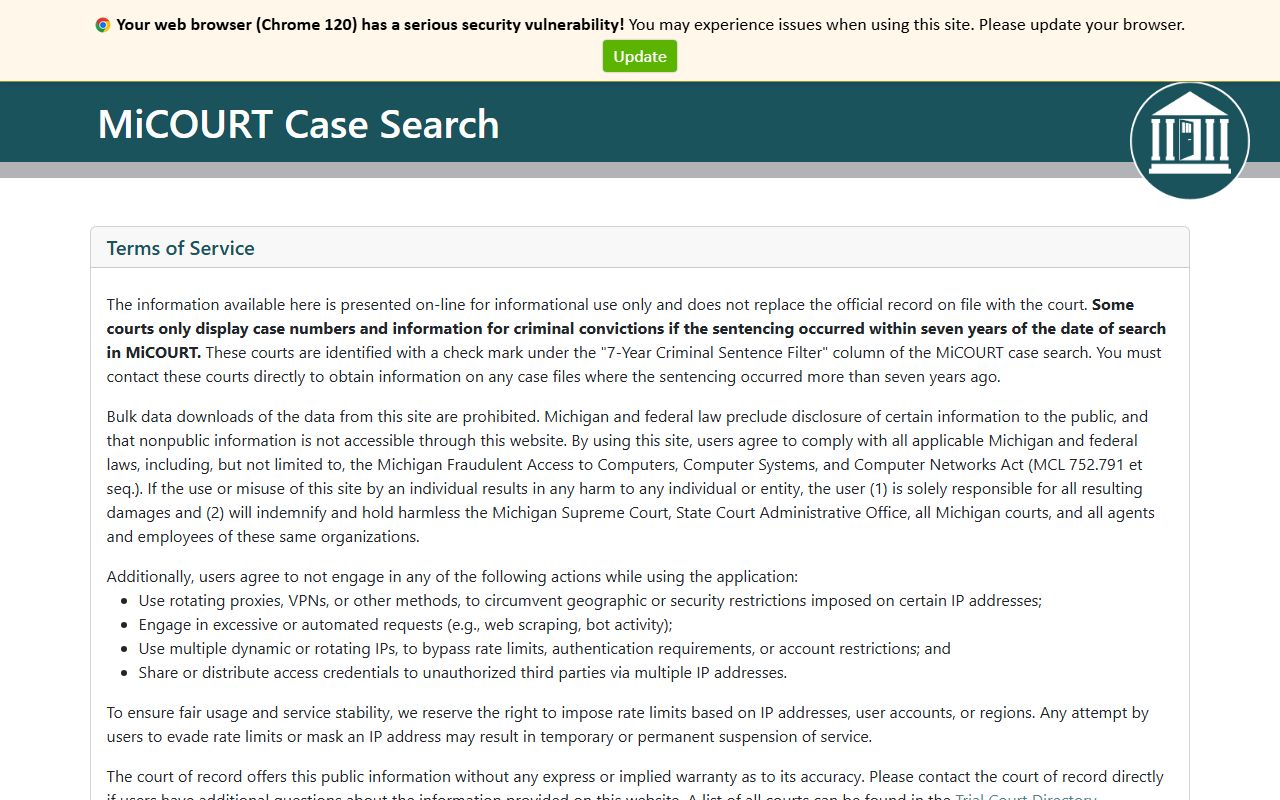
The portal screenshot supports the lookup steps above, but a clerk should verify any case detail before court action or travel.
| Field Label | Type | Required | Notes |
|---|---|---|---|
| Court | Dropdown or filter | Unspecified | Select the court or jurisdiction when the portal exposes that filter. |
| Case type | Dropdown or filter | Unspecified | Criminal, traffic, civil, domestic, or probate options may vary by court. |
| Name | Text | Unspecified | Use the defendant or party name and confirm spelling. |
| Case number | Text | No | Best for direct lookup when a court notice or bond paper gives the number. |
| Date filters | Date or filter | No | Useful when a common name returns too many results. |
Menominee County Arrest Charging Records
A Menominee County jail arrest can begin with an officer taking a person into custody, but the court record starts when a charging document is filed. Local District Court material says a criminal case begins when the prosecuting attorney files a complaint against the defendant. If the defendant has not already been arrested, an arrest warrant may issue when the complaint is filed. If the person is already in custody, the first court appearance is the arraignment, where charges, rights, possible penalties, and bond are addressed.
Felony cases have extra steps. The prosecutor's process page states that, for a felony complaint, a law-enforcement officer gives sworn testimony to a magistrate or judge to support probable cause. After District Court arraignment, a Probable Cause Conference is scheduled between 7 and 14 days later. The preliminary examination is supposed to be scheduled 5 to 7 days after that conference. If the charge survives or the exam is waived, the case is bound over to Circuit Court and an Information gives formal notice of the felony charges.
| Complaint | Information | Indictment | |
|---|---|---|---|
| Filed By | Prosecuting Attorney in District Court | Prosecutor after felony bindover | Grand jury process, not the routine local path described in county sources |
| Common For | Misdemeanors and felony starts | Felony cases in Circuit Court | Serious matters where a grand jury is used |
| Starts | The criminal court case | The formal Circuit Court felony charge stage | A case or charge through grand jury action |
| Menominee Context | Directly described by District Court and prosecutor pages | Directly described after bindover | Not highlighted as the normal Menominee County process |
Menominee County Charge Status Records
Charge status in court records after a Menominee County arrest should be read as a moving case history. A jail booking reason may reflect the officer's intake label or the arrest basis, while the court charge reflects the prosecutor's filing decision. Charges can be authorized, declined, amended, reduced, dismissed, resolved by plea, or proven at trial. Misdemeanor arraignment may include a guilty plea, a not guilty plea, a no-contest plea, or a stand-mute entry. Felony arraignment in District Court does not take a guilty or not guilty plea in the same way, because the case must pass through conference and preliminary examination stages first.
| Status | What It Means |
|---|---|
| Pending | The charge has been filed and the case has not reached final disposition. |
| Amended or Reduced | The prosecutor or court record now shows a changed charge, often after review, plea talks, or hearing results. |
| Dismissed | The charge is no longer proceeding, though other charges in the same case may remain. |
| Bound Over | A felony passed from District Court to Circuit Court after probable cause was found or the exam was waived. |
| Convicted | The case ended in a guilty plea, no-contest plea accepted by the court, or trial verdict. |
Michigan State Police ICHAT criminal history is a separate statewide criminal-history access point. It should not be treated as a complete substitute for a court file. Court records show filings and case events. ICHAT focuses on public criminal history data and has its own limits, including removal rules for certain qualifying nonconviction arrest records.
Menominee County Bond Records
Bond in Menominee County is a court decision. The 95A District Court page states that District Court handles initial adult criminal arraignments, including setting bail and accepting bonds. The District Court criminal-case page adds that a person who has been arrested is held by law enforcement until bond is set and/or arraignment takes place. At arraignment, a judge or magistrate explains the charges, constitutional rights, and possible consequences, then determines whether release on bond is allowed and what the bond amount or conditions will be.
The sheriff and jail pages identify the practical payment channel. Menominee County accepts credit and debit card payments through AllPaid, formerly GovPay, and the county lists Bond Payments PLC 5264. A transaction fee applies. Before paying, confirm the amount with the jail or District Court, and ask whether a second hold exists. A parole hold, probation hold, warrant from another court, federal matter, ICE detainer, or other agency hold can keep a person in custody even after local bond is paid.
| Bond Type | How It Works |
|---|---|
| Cash Bond | Money is paid to satisfy the court's release order. |
| Surety Bond | A bonding company or approved surety arrangement may be used when the court allows it. |
| Personal Recognizance | The defendant is released on a promise to appear and comply with conditions. |
| Conditional Bond | Release includes rules such as no contact, testing, travel limits, or no alcohol or drugs. |
| No-Bond Hold | Payment alone will not release the person because another legal hold controls custody. |
Menominee County Warrant Records
No official Menominee County public active-warrant search or sheriff warrant list was located in the county sources reviewed. That does not mean warrants are absent. It means a public lookup path must use official contact points. The District Court criminal-case page says an arrest warrant is issued when a complaint is filed if the defendant has not already been arrested. The prosecutor process page also notes that delay between the crime date and arrest can vary when the defendant's location is unknown or the person has left Michigan.
For warrant-related court records after an arrest, call the Menominee County Jail or Sheriff's Office at 906-863-4441 for custody routing, call 95A District Court at 906-863-8532 for District Court case questions, and call the Circuit Court or County Clerk at 906-863-9968 for felony or circuit matters. MiCOURT may show the related case if public data is available. A person who believes a warrant exists should not rely on a web search alone. Legal counsel is the safer route for surrender, clearance, or appearance planning.
- Arrest warrant
- A court order to bring a defendant before the court after a complaint and probable cause process.
- Bench warrant
- A judge's warrant, often tied to failure to appear or failure to comply with a court order.
- Detainer
- A notice or request from another agency that may keep a person in custody after local bond is posted.
Menominee County Charge Records
Menominee County court records after a jail arrest can show charges before any conviction exists. A charge is an accusation filed through the criminal process. A conviction is the result of a guilty plea, accepted no-contest plea, or trial verdict. This distinction is important for employment, housing, licensing, and personal decisions, but any FCRA-covered use must come from a legally compliant consumer-reporting process, not from casual public-record browsing.
| Charge | Conviction | |
|---|---|---|
| Stage | Accusation filed in court | Final finding by plea or verdict |
| Proof Level | Probable cause or filing standard | Beyond a reasonable doubt or valid plea basis |
| Record Meaning | Shows what was alleged at that point | Shows legal responsibility for an offense |
| Can Change | Yes, it may be amended, reduced, or dismissed | It may later be appealed or set aside if eligible |
Menominee County Set Aside Records
Michigan uses set-aside language for many adult conviction-clearing rules. MCL 780.621 governs eligibility and the process for setting aside certain adult convictions. A set-aside can limit public access to a conviction record, but it does not mean every agency file, court trace, or nonpublic law-enforcement record disappears from all systems. The correct path depends on the charge, disposition, timing, and prior history.
Michigan also has an arrest-record removal rule for certain nonconviction outcomes. MCL 764.26a covers removal of qualifying arrest records from ICHAT after prosecutor agreement or other nonconviction-related outcomes. Menominee County court records after an arrest may still require checking with the court and originating agency to confirm what is public, what is sealed by law, and what remains available to criminal-justice agencies.
| Sealed or Nonpublic | Set Aside or ICHAT Removal | |
|---|---|---|
| Public View | Hidden or restricted by court order or statute | Public conviction or arrest-history access may be limited when eligibility is met |
| Law Enforcement | May retain limited or criminal-justice access | May retain access depending on the law and record type |
| Eligibility | Depends on case type, age, and legal basis | Depends on Michigan set-aside or qualifying nonconviction rules |
| Where to Verify | Court clerk and originating agency | Court file, prosecutor status, MSP ICHAT, and legal counsel |
Restricted Menominee County Arrest Records
Michigan FOIA starts from a broad public-policy rule. MCL 15.231 says people are entitled to full and complete information about government affairs and official acts, subject to exemptions. MCL 15.235 sets the public body's response obligations after a written request. Menominee County's FOIA page applies that framework locally, with a five-business-day response window and one possible extension of not more than ten business days.
Some court records after a Menominee County jail arrest may be restricted. Juvenile matters, sealed cases, victim-protected material, medical details, personal identifiers, law-enforcement investigation records, and records protected by another statute may be withheld or redacted. If a court record is public but not visible in MiCOURT, the clerk may still be the right source. If the desired item is a police, jail, or booking record rather than a court filing, use the Menominee County FOIA process and describe the record with the full name, date of birth if known, arrest or booking date, agency, report number, case number, and exact records sought.
Important: Public case lookups are not FCRA consumer reports and cannot be used for employment, housing, credit, insurance, or tenant screening decisions.